Chain-of-Goals Hierarchical Policy for Long-Horizon Offline Goal-Conditioned RL
Abstract
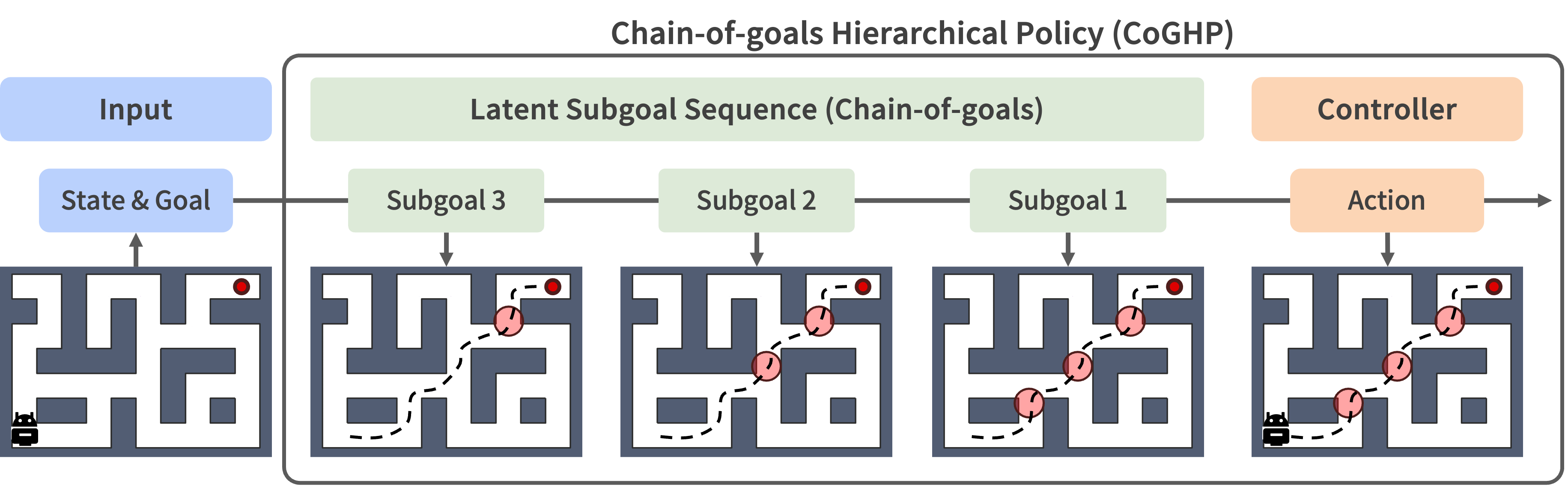
Long-horizon offline goal-conditioned reinforcement learning remains challenging, as errors compound over extended decision sequences and single-subgoal hierarchies often lose awareness of the final goal. Inspired by the sequential decomposition principle behind chain-of-thought reasoning, Chain-of-Goals Hierarchical Policy (CoGHP) is a unified hierarchical policy that decomposes long-horizon decision-making into a sequence of intermediate steps before generating an action.
Instead of relying on separate high-level and low-level policies, CoGHP reformulates hierarchical decision-making as autoregressive sequence generation. Given a current state and a final goal, CoGHP generates a chain-of-goals, a sequence of latent subgoals followed by the primitive action. Each latent subgoal serves as an intermediate reasoning step that guides subsequent predictions while preserving awareness of the final goal throughout the decision process.
To realize this within a single model, CoGHP adopts an MLP-Mixer backbone augmented with a learnable causal token-mixer, enabling efficient cross-token communication and end-to-end training of both intermediate subgoals and primitive actions under a shared goal-conditioned value function.
Challenges
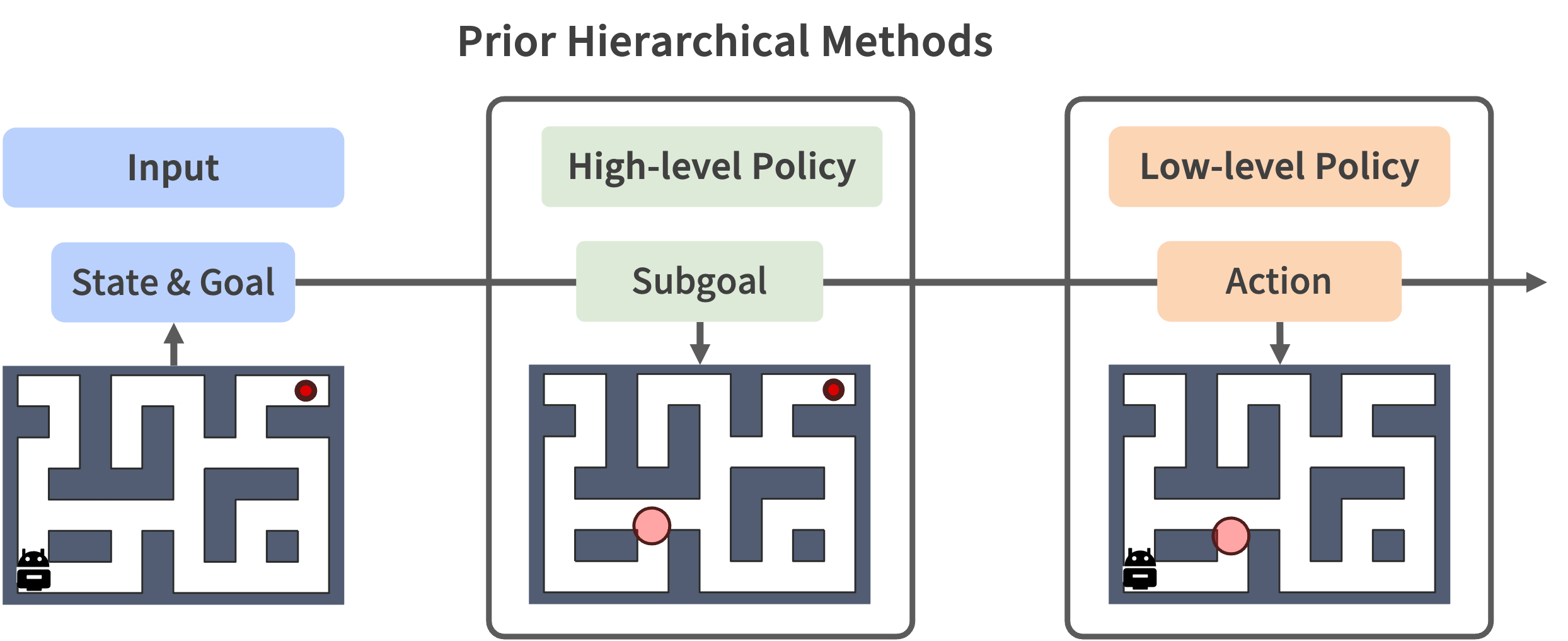
Existing offline hierarchical reinforcement learning methods often decompose long-horizon tasks into high-level subgoal selection and low-level control. While this decomposition is effective for temporal abstraction, it also introduces three structural limitations:
1. Single-Subgoal Abstraction
- A single intermediate subgoal may not capture complex multi-stage tasks.
- Many tasks require multiple intermediate decisions before reaching the goal.
2. Loss of Final-Goal Awareness
- A separated low-level policy may follow an imperfect subgoal while ignoring the final goal.
- This can lead to suboptimal actions in long-horizon tasks.
3. Fragmented Optimization
- Separate high-level and low-level objectives make end-to-end hierarchical learning difficult.
- Learning signals are split across hierarchy levels, limiting coordination.
These limitations motivate a unified framework that can generate multiple intermediate subgoals and the final action within a single model.
Main Idea
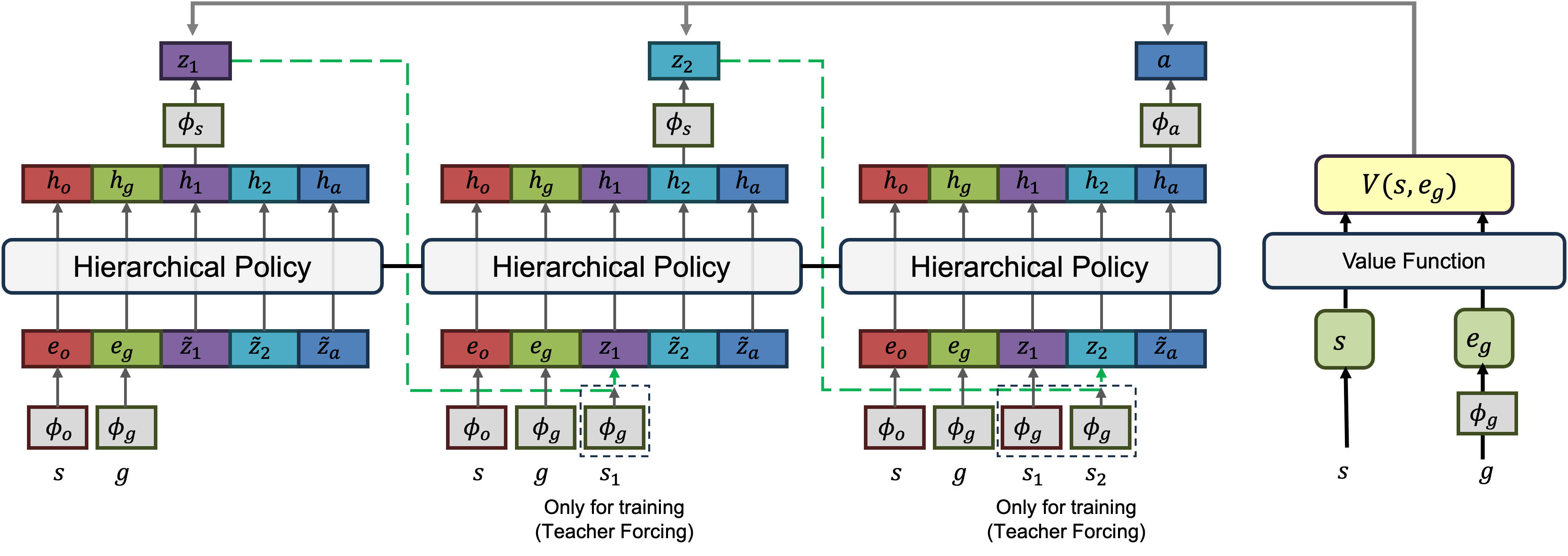
CoGHP turns long-horizon control into a chain-of-goals generation problem. Inspired by chain-of-thought reasoning, CoGHP replaces the separate high-level and low-level networks of conventional hierarchical RL with a single unified model. Built on an MLP-Mixer-based hierarchical policy, it autoregressively generates multiple latent subgoals from the current state and final goal, and then predicts the primitive action, all trained end-to-end.
Generating a chain of goals
Instead of relying on a single intermediate target, CoGHP generates a sequence of latent subgoals that progressively bridge the gap between the current state and the final goal.
Each latent subgoal serves as an intermediate reasoning step, allowing the policy to represent long-horizon decision-making as a structured chain of goals rather than a single planning step.
State + Goal → Subgoal H → ... → Subgoal 1 → Action
Autoregressive Subgoal Generation
CoGHP generates the subgoals autoregressively, so that each prediction is conditioned on the previously generated subgoals as well as the state and final goal. This sequential formulation brings three key benefits:
- Multi-step decomposition: A long-horizon task is broken down into several intermediate goals rather than a single planning step.
- Final-goal awareness: The final goal stays part of the input throughout generation, so the policy never loses sight of where it is headed.
- Unified decision-making: Subgoal generation and action prediction are trained together within a single model.
A Single Shared Value Function
Every element of the chain, each latent subgoal and the final action, is trained under a single shared goal-conditioned value function.
Since the value function is learned over state-embedded goals and the latent subgoals reside in the same embedding space, it can directly score both subgoals and actions. This lets CoGHP apply consistent advantage-weighted signals across the entire chain, so that subgoal generation and action prediction are optimized together within one model.
V(s, g) → scores every subgoal and the action
Because a single value function guides the whole reasoning chain, training signals stay coherent from the farthest subgoal down to the primitive action, complementing CoGHP's unified autoregressive design.
Why MLP-Mixer instead of Transformer?
Although this problem can be viewed as sequence modeling, CoGHP's token sequence is different from natural language. Each token has a fixed role:
current state | final goal | latent subgoals | action
In this structured setting, the flexibility of self-attention is not always necessary. CoGHP uses an MLP-Mixer backbone to efficiently exchange information across these fixed-role tokens through simple token-mixing and channel-mixing operations. This provides a suitable inductive bias for hierarchical decision-making while keeping the model unified and stable.
In short, CoGHP formulates long-horizon control as autoregressive chain-of-goals generation, producing a sequence of latent subgoals before predicting the final action.
Results
Quantitative Results

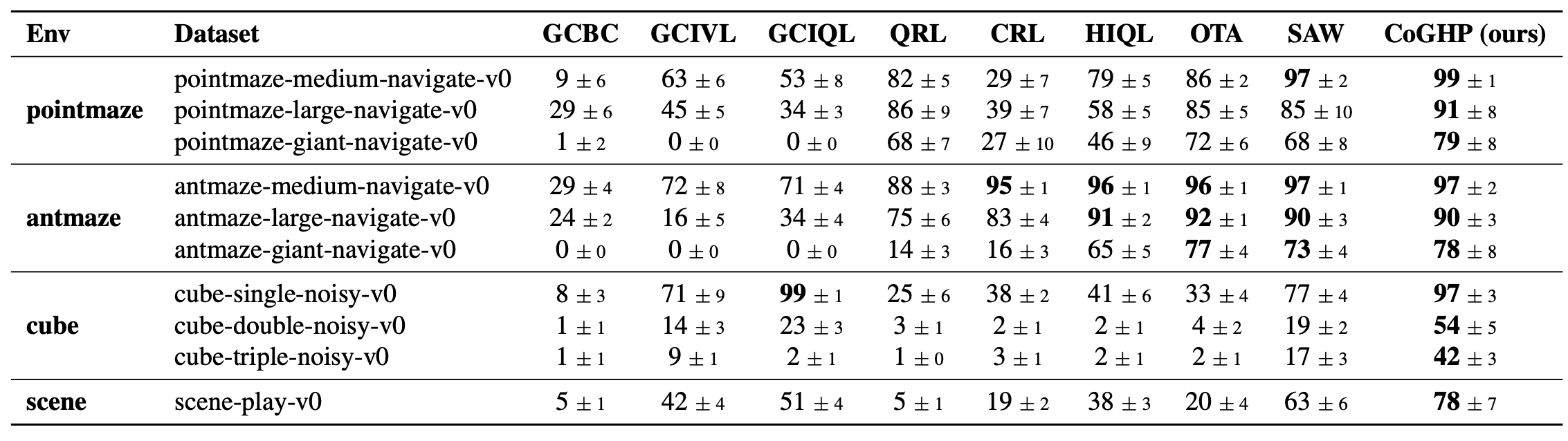
We evaluate CoGHP on challenging navigation and manipulation tasks from OGBench. CoGHP achieves strong performance across diverse environments, including PointMaze, AntMaze, Cube, and Scene tasks. In long-horizon navigation tasks, CoGHP shows clear gains in complex maze environments, where multi-stage reasoning is important. In manipulation tasks, CoGHP also performs strongly on sequential object interaction tasks, demonstrating the benefit of unified subgoal generation and action prediction.
Subgoal Visualizations
To better understand how CoGHP decomposes long-horizon tasks, we visualize the generated latent subgoals in AntMaze. The visualization shows that CoGHP produces intermediate subgoals along meaningful paths toward the final goal. These subgoals provide structured guidance for the policy, illustrating how the chain-of-goals helps the agent break down a complex task into a sequence of intermediate steps.
Citation
@article{choi2026chain,
  title={Chain-of-Goals Hierarchical Policy for Long-Horizon Offline Goal-Conditioned RL},
  author={Choi, Jinwoo and Lee, Sang-Hyun and Seo, Seung-Woo},
  journal={arXiv preprint arXiv:2602.03389},
  year={2026}
}
The website template was partly borrowed from Michael Gharbi, and Jon Barron.